


Analysis Region: Gyeonggi-do and 31 cities and counties Educational Zone
Core Areas: AI industrial clusters such as Seongnam and Pangyo, Northern and Eastern Gyeonggi and areas with limited access to education, vocational high schools and AI-focused schools
Agenda: The future intelligence gap among students in the AI era and structural differences in school, regional, and teacher capabilities
Golden Time Type: Opportunity + Structural Risk
Reference Date: August 28, 2026
Version: Regional AX Golden Time Intelligence v3.1
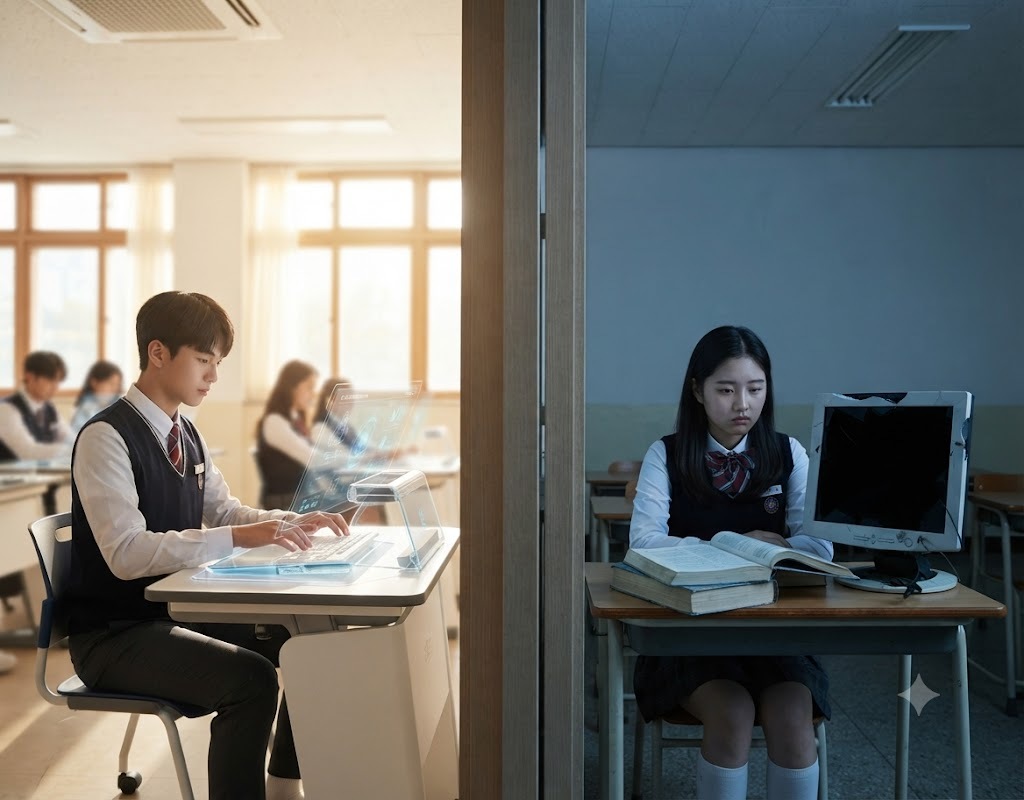
Viewing the issue of AI education for Gyeonggi-do students merely as a matter of "whether they have the opportunity to learn AI" leads to overlooking the actual gap. By 2026, the Gyeonggi Provincial Office of Education is rapidly expanding AI education through initiatives such as establishing 200 AI-focused schools , 350 leading schools for AI and digital utilization , deploying digital tutors to approximately 600 schools, employing about 100 members of a specialized support team for AI convergence education, and designating 19 vocational high schools as AI competency enhancement schools. It is clear that school-level AI education has moved beyond a few pilot schools and entered a phase of widespread adoption. ( Government Electronic Procurement Center )
The foundation is not weak either. As of October 2024 , Hi-Learning , the Gyeonggi Provincial Office of Education's proprietary AI teaching and learning platform, was already being used by 2,581 schools, 491,607 students, and 38,613 teachers. Since then, features such as AI essay diagnosis, AI short-answer and essay-type assessments, personalized content recommendations, and learning data utilization have been continuously advanced. While this represents the Historical Official Baseline , it signifies that Gyeonggi Province has secured a substantial level of public digital infrastructure to expand AI education. ( Government Electronic Procurement Center )
However, the quantitative expansion of AI education is not the same as bridging the future intelligence gap for students. Actual experiences can vary depending on which school a student attends, whether there are teachers capable of designing AI lessons, the presence of universities, IT companies, and research institutes in the region, whether there is an environment at home to utilize AI, and whether schools use AI not merely as a learning tool, but as a tool for problem-solving, creativity, and critical thinking. The fact that the Gyeonggi Provincial Office of Education explicitly stated "bridging the digital divide" as a project objective while separately operating mobile AI experiential education for six middle schools in Yeoncheon, Yeoju, and Anseong in 2025 demonstrates that these spatial differences are being recognized at a policy level. ( Korea Electronic Procurement Service )
A more significant issue is that the future gap is shifting from a gap in device ownership to a qualitative gap in AI utilization . Even if the same AI tools are provided to all students, one student might use them to copy answers, while another could use them to validate materials, write code, analyze data, and solve new problems. This difference represents a capability at a higher level than mere digital literacy.
Therefore, this analysis views this as a matter of Future Intelligence . Future Intelligence is not merely the ability to use specific AI programs, but rather a student's comprehensive competency that leads from questioning → exploration → verification → analysis → AI collaboration → problem-solving → creation → responsible judgment. Gyeonggi Province's Golden Time does not lie in creating more AI education projects. It lies in whether, within the next two to three years, public education can guarantee a minimum level of Future Intelligence regardless of students' residential areas, schools, teachers, or home environments, while simultaneously connecting local industries with students' advanced AI capabilities .
Gyeonggi-do education is the largest education system in South Korea. At the same time, because the industries, populations, incomes, and urban-rural structures of the 31 cities and counties vary significantly, the educational environment is also difficult to explain using a single average.
Areas such as Seongnam, Suwon, Yongin, and Hwaseong have a relatively high potential for connecting with the Pangyo IT and AI industries, semiconductor and high-tech manufacturing companies, and universities and research institutions. On the other hand, in areas like Yeoncheon, Gapyeong, Yangpyeong, and Yeoju, it is structurally difficult to secure the same types of private AI education and opportunities for industry linkage.
The Gyeonggi Provincial Office of Education’s differentiated design of AI-focused schools for 2026— comprising 3 leading-type schools, 100 central-type schools, and 97 cultural diffusion-type schools— is also based on the premise that AI educational capabilities vary from school to school. In particular, leading-type schools are required to operate at least 68 hours of information technology classes for elementary schools and 102 hours for middle schools, while high schools are mandated to schedule AI-related subjects every semester. ( Government Electronic Procurement Center )
At the same time, the 350 leading schools utilizing AI and digital technology are structured to develop Hi-Learning-based classes, digital content, and customized education models tailored to student characteristics, and to disseminate them through inter-school networks. ( Government Electronic Procurement Center )
Therefore, a multi-layered AI education structure consisting of a universal platform + leading schools + key schools + regional hubs is already being formed in Gyeonggi-do .
The question is how much this structure is actually being converted into equal opportunities at the student level.
The fact that there are 200 AI-focused schools and 350 AI and digital utilization leading schools is an important output. However, these numbers cannot be equated with the improvement of students' AI capabilities.
- Designation as an AI-focused school ≠ Enhancement of students' future intelligence
- Accessing Hi-Learning ≠ Securing AI utilization capabilities
- Digital tutor deployment ≠ Teacher instructional innovation
- It is necessary to distinguish between AI experiential education and continuous AI learning.
The role of the teacher is particularly crucial in AI education . Even when the same platform and AI tools are provided, the quality of instruction can vary significantly depending on the questions the teacher formulates and the verification process required of students.
The Gyeonggi Provincial Office of Education’s formation of a specialized support team consisting of approximately 100 teachers who obtained master’s degrees in AI convergence education by 2026 , and its implementation of on-site consulting, practical training, and lesson model development, are also aimed at reducing the competency gap among teachers in schools. ( Government Electronic Procurement Center )
In addition, 172 new students will be selected for a specialized AI convergence education program linked with graduate schools of education, and 70% of the tuition per semester, up to a maximum of 2 million won, will be subsidized. This demonstrates that the bottleneck in AI education is not only the equipment but also the expertise of teachers. ( Government Electronic Procurement Center )
Therefore, the next evaluation unit for AI education in Gyeonggi- do should be not the number of schools, but what actual AI competencies students have acquired .
Prior to the advent of AI, the digital education gap was primarily a matter of access to devices, the internet, and software. With the advent of generative AI, the nature of the gap is changing.
The first change is the shift from search to question . Rather than the ability to search for necessary information, it is becoming more important what questions to ask the AI and how to verify the answers.
The second is the shift from knowledge acquisition to knowledge verification . Because AI generates answers quickly, students must be able to judge the source, logic, errors, and biases of the information.
The third is the shift from tool utilization to AI collaboration . The ability to solve problems with AI is becoming important in almost all areas, including writing, coding, data analysis, imaging, design, and experimentation.
The fourth point is a change in evaluation methods. In an environment where students can use AI, it becomes difficult to assess their actual capabilities based solely on simple deliverables. The Gyeonggi Provincial Office of Education's introduction of the Hi-Learning AI essay-type evaluation system and the enhancement of essay diagnostic functions are also linked to this change. ( Government Electronic Procurement Center )
Therefore, the educational gap in the AI era is likely to shift from the difference between students who can use AI and those who cannot to the difference between students who can use AI as a tool to expand their thinking and those who use it as a tool to generate answers for them .
The Gyeonggi Provincial Office of Education's 2026 AI education policy is largely composed of four layers.
The first is the expansion of AI education hubs . We are currently operating 200 AI-focused schools and 350 AI and digital utilization leading schools. Focused schools reinforce AI and information education itself, while leading schools play a role in expanding high-learning and digital-based personalized classes. ( Government Electronic Procurement Center )
The second aspect is support for the school field . 14.9 billion won was invested in the Digital Tutor project, and deployment was pursued across approximately 600 schools. Tutors are designed to allow teachers to focus on teaching and learning itself by supporting lesson preparation and the use of digital devices and platforms. ( Korea Electronic Procurement Service )
The third aspect is teacher competency . Approximately 100 members of the AI Convergence Education Specialized Support Team, 172 participants in the Graduate School of Education's AI Specialized Course, and Hi-Learning-based teacher training are being operated simultaneously. The Institute for Future Science Education's Hi-Cycle is designed to diagnose teachers' AI and digital competencies across six areas—safety and ethics, digital literacy, EdTech, data, computational thinking, and AI—and connect this to actual classroom practice. The goal is to develop and share 3,000 Hi-Learning-based lesson plans by 2026. ( Government Electronic Procurement Center )
The fourth point is the connection with industrial and vocational education . Nineteen schools have been selected for the 2026 Vocational High School AI Competency Enhancement Project, which operates programs ranging from AI basics to major convergence and AI capstone design projects that solve challenges in industrial settings. ( Government Electronic Procurement Center )
In other words, the Gyeonggi Provincial Office of Education’s AI education has begun to shift from simple coding education to Education AX, which encompasses subject classes, assessment, teachers, and vocational education .
Gyeonggi Province's greatest strength is its ability to connect its proprietary AI teaching and learning platform with an extensive network of schools.
As of October 2024, Hi-Learning was already being utilized by 2,581 schools, 491,607 students, and 38,613 teachers. Even at that time, features such as AI essay-type diagnostics, chatbots, and content recommendations were being advanced. ( Korea Electronic Procurement Service )
These public platforms hold significant meaning in alleviating educational disparities, as they can provide the same basic services regardless of the financial capacity of regions or schools.
However, educational competitiveness cannot be judged solely by platform penetration rates. In the AI era, teachers' lesson design capabilities, students' critical thinking and AI ethics, and project experience with local industries are all required together.
The Gyeonggi Provincial Office of Education’s decision to separately distribute "Guidelines for the Safe Use of Generative AI" for students and teachers starting in 2025 is also a result of recognizing these risks. The guidelines emphasize the responsible use of Generative AI and digital citizenship education, taking into account age-specific characteristics and the role of teachers. ( Korea Electronic Procurement Service )
Therefore, while Gyeonggi-do's AI education readiness can be assessed as quite high in terms of platforms and policy foundations, there is still significant room for improvement in the system for measuring students' actual future intelligence outcomes and regional disparities.
Connecting the figures for 200 AI-focused schools, 350 AI and digital utilization leading schools, approximately 600 digital tutors, about 100 members of the AI convergence education specialized support team, 172 students in graduate school AI specialized courses, and 19 vocational high schools for AI competency enhancement by 2026 confirms that AI education in Gyeonggi Province is already spreading simultaneously across multiple levels. ( Government Electronic Procurement Center )
However, these numbers are all primarily Input or Output .
Separate outcome data is needed to determine how many students have become able to solve new problems using AI, whether regional disparities in student AI capabilities have narrowed, and how teachers' AI utilization capabilities have affected students' academic achievement, self-directedness, and creativity.
In particular, the fact that the Mobile AI Station was operated for six middle schools in Yeoncheon, Yeoju, and Anseong in 2025 serves as policy evidence demonstrating that accessibility to AI industry and experience infrastructure can vary by region . ( Korea Electronic Procurement Service )
Therefore, to assess the educational AI gap in Gyeonggi-do, going forward, we must simultaneously examine data from at least five layers: school → teacher → student → home → region.
The first is the gap in AI education experience between schools . While students in 200 key schools and 350 leading schools are likely to experience a relatively diverse range of AI classes, separate verification is required to determine whether this has spread to general schools to the same extent.
The second is the teacher competency gap . The difference between teachers who use AI for simple data generation and those who utilize it for student data analysis, personalized instruction, and project-based learning leads to differences in student experience.
The third is the regional ecosystem gap . The quality of out-of-school AI projects and career experiences can differ between regions with easy access to IT companies in Pangyo and universities and research institutions, and those without.
The fourth is the home environment gap . Paid AI services, high-performance devices, private education, and parents' digital capabilities can expand students' experience with AI outside of school.
The fifth is the evaluation gap . There are currently insufficient public comprehensive indicators that can equally compare the AI, data, verification, and problem-solving abilities of Gyeonggi-do students by city, county, and school.
The most critical data gap lies right here. While the AI education business is expanding rapidly, data measuring the actual gap in students' future intelligence is relatively lacking.
The first foundation of Education AX is a public platform accessible to all schools. In this regard, Hi-Learning is an important asset of Gyeonggi-do.
However, a platform alone is not enough. It simultaneously requires teachers and digital tutors capable of properly utilizing AI in the classroom, stable networks and devices, AI content, student learning data, and standards for personal information protection and AI ethics.
In particular, Hi-Cycle, introduced by the Gyeonggi Provincial Office of Education’s Institute for Future Science Education in 2026, assesses teacher competencies across six areas : digital safety and ethics, digital literacy, EdTech, data, computational thinking, and AI. This can also serve as an important reference structure for designing future student intelligence indicators. ( Government Electronic Procurement Center )
The student needs one more step here.
We must evaluate not only the ability to use AI, but also the ability to formulate questions, verify AI answers, interpret data, distinguish between human and AI roles, and take responsibility for results .
The role of public education in the AI era is not to purchase the best AI services for students, but to enable them to acquire this basic future intelligence regardless of their home environment .
For Education AX to reach the local community, AI education within schools must be connected with local industries.
Gyeonggi Province offers particularly favorable conditions in this regard. It possesses resources where students can experience real-world industrial challenges, such as AI and software in Pangyo, semiconductors in Yongin, Hwaseong, Pyeongtaek, and Icheon, biotechnology in Siheung and Gwanggyo, and robotics and smart factories in manufacturing-intensive areas.
Changes in AI education at vocational high schools demonstrate this direction. The AI competency enhancement project, to be implemented in 19 schools by 2026, focuses not on simple AI theory, but on projects that solve industrial problems using AI, as well as interdisciplinary majors and capstone design. ( Korea Electronic Procurement Service )
The problem is the possibility that these opportunities will be concentrated only in some vocational high schools and industrial clusters.
To reduce regional disparities in AI education, it is necessary to remotely connect classes and projects with experts from companies in Pangyo, operate mobile AI labs, and transform regional industrial issues into shared school projects.
Ultimately , it is important to see how much public education can correct a structure where only students from areas with many local industries experience future industries .
The educational gap in Gyeonggi Province is not simply a matter of the south versus the north. Even within the same city, differences can arise depending on school and home environments.
However, there are clear spatial differences when considering the connection between the local industrial ecosystem and AI education. The Seongnam Office of Education has been selected as a Leading District for AI and Digital Utilization for four consecutive years until 2026 and is operating the '6·5·5 AI-Hub' and the 'Seongnam Digital Ladder,' which links Pangyo IT companies with the local government. ( Government Electronic Procurement Center )
In contrast, Yeoncheon, Yeoju, and Anseong sent mobile AI Stations directly to schools in 2025 to provide opportunities for AI experiences. This implies that the very method of providing the same AI education varies by region. ( Government Electronic Procurement Center )
However, it is also inappropriate to simply characterize Northern Gyeonggi as a vulnerable region for AI education. The Yeoncheon Office of Education formed the AIDed Lesson Sharing Support Team in 2026, consisting of 26 elementary, middle, and high school teachers within its jurisdiction, to promote the expansion of High Learning and AI-based short-answer and essay-type assessments. This serves as evidence that even latecomer regions are beginning to build their own capabilities. ( Government Electronic Procurement Center )
Therefore, what is needed is not a simple ranking of regions, but measuring AI Education Readiness for each of the 31 cities and counties .
The first reason is that AI is already becoming an everyday learning tool for students. Students use AI even if schools do not teach how to utilize it. Therefore, the longer public education is delayed, the greater the likelihood that AI usage will be determined by home environments and private education.
The second reason is that the Gyeonggi Provincial Office of Education is simultaneously expanding AI-focused schools, pilot schools, digital tutors, and professional teacher training programs by 2026. It is highly likely that the lesson models and teacher competency frameworks currently being developed will become the standard for AI education in general schools in the future. ( Government Electronic Procurement Center )
The third reason is that the evaluation system has begun to change. AI-based short-answer and essay assessments, as well as the AI-based English class and assessment model 'CLASS UP,' are being introduced. Following the operation of pilot schools in 2026, CLASS UP is planned to be gradually expanded to all general schools in the province by 2027. ( Government Electronic Procurement Center )
Once an evaluation method and training data structure are established, the cost of changing them again is high.
Therefore, the period from 2026 to 2028 is the Golden Time for Gyeonggi Province to decide whether to treat AI as a private education tool that widens the educational gap, or to develop it into a public infrastructure that guarantees the minimum standard of future intelligence in public education .
12-1. Golden Time Application Case in Basic Local Governments ① — Seongnam City
Seongnam is one of the regions in Gyeonggi Province where students can experience the AI industry firsthand. It can connect the cluster of AI and software companies in Pangyo Techno Valley with school education, and the Seongnam Office of Education has been selected as a Leading District for AI and Digital Utilization for four consecutive years from 2023 to 2026. ( Government Electronic Procurement Center )
In 2026, the '6·5·5 AI-Hub' education model, which reflects the characteristics of elementary, middle, and high school levels, will be launched, and efforts to alleviate the educational gap are being pursued through the 'Seongnam Digital Ladder,' which connects local governments with IT companies in Pangyo. This is significant in that it represents an attempt to transform the AI industry cluster into an educational resource. ( Government Electronic Procurement Center )
Seongnam's Golden Time does not lie in creating more AI experiential education programs. It is crucial to connect Pangyo's businesses, talent, data, and on-site issues with school projects, and to turn these educational models into public assets so that students in other regions can utilize them through initiatives such as Hi-Learning and Gyeonggi Shared Schools .
If Seongnam's excellent local resources become a competitive advantage exclusive to Seongnam students, the educational gap in Gyeonggi Province will widen. Conversely, if these resources are transformed into shareable assets for classes, projects, and mentoring, a structure can be created where leading regions elevate the future intelligence of lagging regions .
12-2. Golden Time Application Cases in Basic Local Governments ② — Yeoncheon-gun
Yeoncheon is an important case study under conditions diametrically opposed to those of Seongnam. Although it is not a region densely populated with AI and IT companies, this very fact allows for a clearer verification of the role of public education.
The Gyeonggi Provincial Office of Education operated the "Visiting AI Station" at six middle schools in Yeoncheon, Yeoju, and Anseong in 2025. This project involved sending mobile experience centers to schools to provide AI technology and digital citizenship education, and the Office of Education specified "bridging the digital divide " as one of the project's objectives. ( Government Electronic Procurement Center )
In 2026, the Yeoncheon Office of Education formed the AIDed Lesson Sharing Support Team consisting of 26 elementary, middle, and high school teachers within its jurisdiction and is promoting the successful implementation of Hi-Learning and AI-based short-answer and essay-type assessments in schools. ( Government Electronic Procurement Center )
Yeoncheon's Golden Time does not lie in creating an educational environment like Pangyo. It is to combine a public AI platform, remote experts, mobile labs, teacher capabilities, and local problem projects to ensure that a student's geographical location does not determine their AI education opportunities.
Students in Seongnam and Yeoncheon do not need to have the same school environment. However, public education must ensure that the starting line for the minimum future intelligence required to live in the AI era is the same.
The first loss is the new entrenchment of the educational gap . The difference between students who use AI for thinking, creation, coding, and data analysis from an early age and those who use it for simple answer generation can accumulate over time.
The second factor is dependence on the home environment. If schools fail to provide sufficient AI education, paid AI services, private tutoring, and parents' digital capabilities could play a larger role in determining students' future intelligence.
The third factor is the regional talent gap. If students in high-tech industrial regions gain experience in various projects with companies and universities, while students from other regions remain limited to simple experiential education, there is a possibility that the regional industrial gap will be reproduced as an educational gap.
The fourth factor is the teacher gap. If the difference between teachers who utilize AI and those who do not widens, the educational experience may vary by class even within the same school.
The fifth point is dependence on AI. If students develop a habit of using AI without verifying the results, their ability to utilize AI may improve, but their independent thinking skills could actually weaken.
Gyeonggi Province is also well-equipped to reduce the AI gap in education.
There is a public platform called Hi-Learning, AI-focused and leading schools, professional teacher training programs, and digital tutors. World-class industrial resources such as Pangyo, semiconductors, biotechnology, and manufacturing are also located nearby.
Therefore, it is important to connect existing assets in a student-centered way rather than creating a new educational platform .
If students, regardless of their location, can receive basic AI education through Hi-Learning, share excellent classes from AI-focused schools, conduct online projects with experts from companies in Pangyo, analyze local problems using data, and share the results, the entire Gyeonggi Province can become a single AI Learning Network.
If this structure is put into operation, Gyeonggi Province can create a public model that uses AI to reduce the educational gap in a region of 14 million residents, going beyond just a few schools that teach AI well.
The next step of Gyeonggi Education AX is to move from school-based project management to student-based future intelligence growth management .
Changes to observe | Things to do with AX | Policy decision | Verification indicators |
| Student AI Competencies | Common Future Intelligence Diagnosis | Customized support for vulnerable students | change in capabilities |
| School AI gap | Readiness Analysis by School | Priority placement of tutors and teachers | School gap |
| Teacher Competencies | AI Class Competency Assessment | Customized training and expert support | Class application rate |
| regional disparities | Comparison of 31 cities and counties | Expansion of mobile and remote education | Participation and achievement gap |
| home environment | Analysis of AI access outside of school | Providing public access to AI | Usage gap |
| AI-focused schools | Analysis of Performance and Class Models | Expansion into general schools | Number of schools spreading |
| Industrial linkage | Corporate-School Project Matching | Education of local industries | Projects · Number of Students |
| Vocational high school | Comparison of industrial demand and capabilities | Major AI Redesign | Employment and job linkage |
| AI Ethics | Usage pattern and error analysis | Strengthening civic education | Verification and source attribution rate |
| Learning Outcome | Comparison before and after AI utilization | Policy expansion and adjustment | Improvement of learning and problem-solving |
In particular, students' future intelligence needs to be measured by separating it into at least the following structures, rather than ranking it by a single score.
AI Literacy → Questioning → Data Literacy → Verification → Critical Thinking → AI Collaboration → Problem Solving → Creation → Ethics & Responsibility
This indicator should be used as policy intelligence to identify educational disparities between schools and regions, rather than for the ranking of individual students.
Opportunity + Structural Risk
The Gyeonggi Provincial Office of Education's AI Education Readiness is not low. On the contrary, it has secured a substantial foundation by simultaneously operating its own AI teaching and learning platform, 200 AI-focused schools, 350 AI and digital leading schools, digital tutors, professional teacher training courses, and an AI evaluation system. ( Government Electronic Procurement Center )
Therefore, the problem with Gyeonggi Province is not that it has not started AI education.
The question is how quickly we can transition the AI education that has already begun into the future intelligence of all students.
In particular, the possibility that gaps between leading schools and general schools, AI industry clusters and non-clusters, teachers with high AI utilization capabilities and those without, and families' access to AI will become entrenched as a new educational gap is a structural risk.
The current stage is assessed as clear Opportunity + Structural Risk .
In future runtime analysis, at least the following evidence must be continuously tracked.
- Distribution of AI-focused schools by city/county
- Distribution of AI and Digital Leading Schools by City/County
- Ratio of AI-focused schools to total schools
- AI training hours per student
- AI and Information Class Hours by School
- Hi-Learning student active usage rate
- Hi-Learning Usage Gap by School
- Actual usage rate of AI personalized learning
- AI utilization rate in short and essay-type assessments
- Student AI Literacy Change
- Student Question, Verification, and Data Competencies
- Generative AI source verification capability
- Student AI Ethics and Safety Awareness
- Teacher AI Competency Assessment Results
- AI class application rate by teacher
- Digital Tutor Deployment Areas and Effects
- Accessibility to AI Experience Education by Region
- Number of AI industry-linked projects
- Regional corporate and university mentor participation
- Vocational High School AI Major Convergence Participating Students
- Career and employment linkage following AI education
- The access gap for paid AI and devices in households
- AI competency gap between urban and rural students
- Difference in Outcomes Between Leading Schools and Regular Schools
- Changes in Academics, Creativity, and Self-Directedness Due to AI Utilization
The most significant data gap at present is the lack of public data that measures the future AI intelligence of students in Gyeonggi-do using the same standards and continuously shows the gaps by school, region, and home environment .
Runtime Chain
AI Access → Teacher Competencies → Classroom Experience → Student AI Utilization → Questioning, Verification, Analysis → Problem Solving, Creation → Career and Vocational Competencies → Regional Future Talent
The first evidence confirmed in this analysis is that the Gyeonggi Provincial Office of Education has already entered the phase of large-scale expansion of AI education . By 2026, it is operating 200 AI-focused schools and 350 AI and digital utilization leading schools, and the functions of the AI-focused schools have been subdivided into leading, central, and cultural diffusion types. ( Government Electronic Procurement Center )
The second aspect is the infrastructure supporting teachers and schools. 14.9 billion won was invested in the Digital Tutor project, providing support to approximately 600 schools; currently, about 100 members of the AI Convergence Education Expert Support Team and 172 members of the AI Specialized Course at Graduate Schools of Education are in operation. ( Government Electronic Procurement Center )
The third is the public AI learning infrastructure. As of October 2024, HiLearning was used by 2,581 schools, 491,607 students, and 38,613 teachers. However, this is the Historical Official Baseline and should not be used as the current user count for 2026. Currently, the functional scope of the platform is expanding with the addition of AI-based short-answer and essay assessments and personalized learning features. ( Government Electronic Procurement Center )
The fourth is an attempt to reduce regional access disparities. In 2025, mobile AI experience education was conducted for six middle schools in Yeoncheon, Yeoju, and Anseong, while Seongnam is operating an AI and Digital Leading District model in conjunction with IT companies in Pangyo. These two examples demonstrate that AI educational environments are not uniform within Gyeonggi Province and that different complementary policies are required depending on regional conditions . ( Government Electronic Procurement Center )
However, it is difficult to quantitatively determine, based solely on currently available evidence, how much the AI capabilities of Gyeonggi-do students have actually improved, the extent of the difference in AI capabilities between regions such as Seongnam and Yeoncheon, and what differences exist between students in AI-focused schools and those in general schools.
Therefore, it is reasonable to leave this part as a Data Gap .
Structural insights remaining from this analysis
It is highly likely that the AI gap among students in Gyeonggi Province will not appear as simply as the difference between students with and without computers in the future.
Differences occur even among students using the same AI.
One student asks the AI for the correct answer. Another student defines the problem, compares multiple answers, checks the raw data, analyzes the data, and creates a new solution together with the AI.
Although both are recorded as having 'used AI,' their actual future capabilities are completely different.
Therefore, what the Gyeonggi Provincial Office of Education needs to measure going forward is not the AI usage rate, but how students' thinking has expanded through AI .
From this perspective, Hi-Learning, which Gyeonggi Province already possesses, is a significant asset. This is because it can provide personalized education by utilizing student learning data and share excellent teaching models regardless of location. However, this data must evolve beyond simple content recommendations into intelligence that identifies student growth and educational disparities.
Furthermore, Gyeonggi-do's industrial resources, such as Pangyo, semiconductors, and biotechnology, should not be left as educational assets for students in only certain regions. If we can create a Project Library that shares real-world problems provided by companies in Pangyo, Seongnam, semiconductor companies in Yongin, and biotechnology companies in Siheung with all students in Gyeonggi-do , we can actually transform the industrial gap into an educational asset.
Ultimately, the role of public education in the AI era is not to turn every student into an AI developer.
It is to guarantee every student a minimum level of future intelligence capable of knowing what to ask AI, questioning and verifying AI's answers, judging what humans and AI should each do, and solving problems in their local community and society together with AI .
The moment this minimum standard varies by school and region, AI becomes a technology that amplifies existing disparities rather than reducing the educational gap.
Golden Time Thesis — The AI golden time for Gyeonggi-do education does not lie in creating more AI-focused schools and platforms. What will determine the new educational gap in Gyeonggi-do in the AI era is whether public education can guarantee, within the next two to three years, 'minimum future intelligence that asks questions, verifies, analyzes, and collaborates with AI to solve problems,' regardless of students' residential areas, schools, teachers, or home environments.
Version | Reference Date/Revision Date | Major changes |
| v1.0 | 2026.08.28 | Compiled the first analysis of the future intelligence gap for Gyeonggi-do students in the AI era. Verifyed 200 AI-focused schools, 350 AI and digital utilization leading schools, Digital Tutors, Hi-Learning, teacher AI capabilities, AI education in vocational high schools, and application cases in Seongnam and Yeoncheon; determined the "Golden Time" based on the future intelligence gap according to region, school, teacher, and home environments, as well as the Education AX response structure. |
