


Analysis Region: Gyeongsangbuk-
do Core Regions: Major agricultural zones including Sangju, Seongju, Mungyeong, Bonghwa, Cheongsong, Yeongju, Uiseong, Gyeongju, Gumi, and Uljin
Agenda: Is Gyeongbuk, which possesses the nation's largest farm base, transitioning to a structure that enhances productivity, income, and disaster resilience per farm through data, AI, robots, cooperative farming, and distribution automation, rather than addressing farm decline, super-aging, climate risks, and labor shortages, through the expansion of smart farm facilities?
Golden Time Type: Critical + Productivity Conversion Risk
Reference Date: August 28, 2026
Version: Regional AX Golden Time Intelligence v3.2
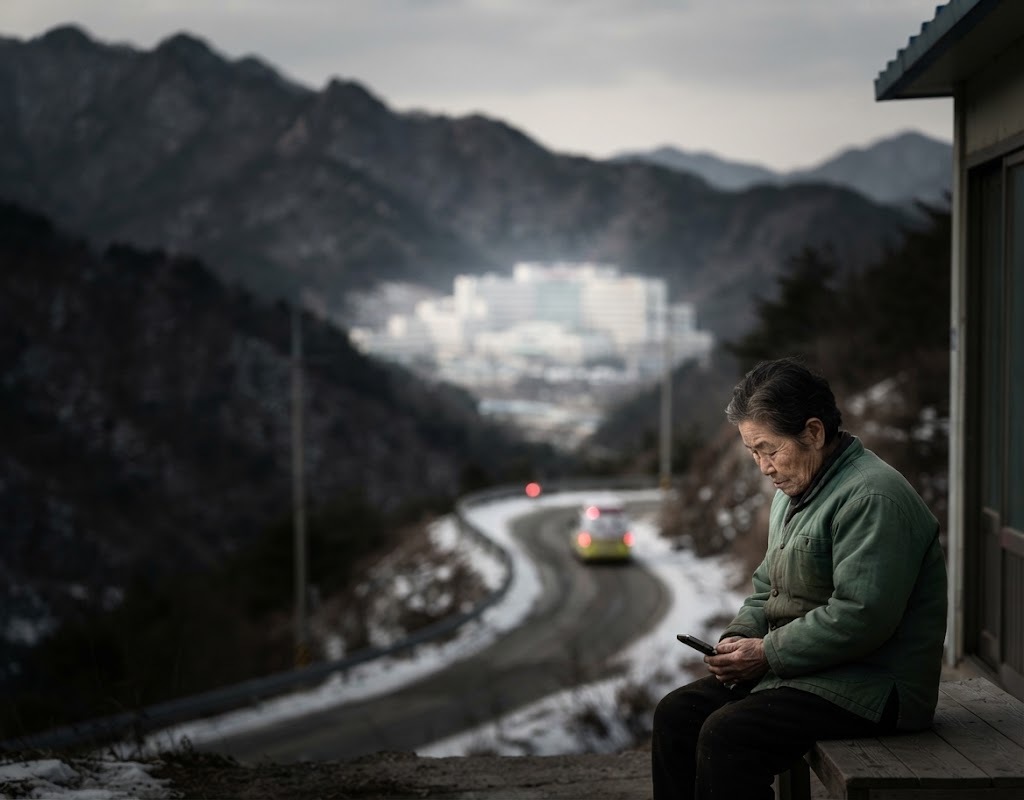
Structural pressures on Gyeongbuk agriculture have already reached a critical threshold. In 2024, Gyeongbuk had approximately 163,000 farm households, accounting for 16.7% of the national total and making it the largest among cities and provinces; however, compared to 2015, the number of households decreased by 11.8% and the farming population by 22.1%. In the same year, the proportion of those aged 65 or older reached 59.2% of the approximately 320,000 farming residents. The problem facing Gyeongbuk agriculture lies not in a future labor shortage, but in the fact that it has entered a stage where it is difficult to maintain the current production system using existing labor input methods. ( National Data Institute )
The production structure also highlights the need for labor reduction and precision agriculture. In 2024, the primary farming type among farms in Gyeongbuk was fruit trees at **30.7%**, followed by paddy rice at 29.4%, and vegetables and wild herbs at 20.4%. Fruit farming is an industry where rural aging is directly linked to production volume, as it involves many tasks that are difficult to automate, such as pruning, thinning, pest control, and harvesting. In fact, apple production in Gyeongbuk decreased by 23.2% from 2015 to 2024, while agricultural management costs increased by 63.0% during the same period. ( National Data Institute )
In 2026, Gyeongbuk explicitly began transitioning to "Agriculture AX" to address this issue . In February, the Gyeongbuk Agricultural Research and Extension Services declared the "Year of the Great AI Transformation for Gyeongbuk Agriculture" and finalized three major strategies: data innovation, robotics, automation, and the nurturing of young farmers. The AI farming log for Korean melons will be expanded from a pilot program involving approximately 40 farms in 2025 to about 100 farms in 2026, and will be integrated with on-device AI cultivation management. Technologies designed to replace actual manual labor are also under development, including strawberry production management robots, cucumber leaf removal robotic arms, and unmanned weeding robots for plum orchards. ( Gyeongbuk Provincial Government )
A more direct transition has begun in the fruit industry. In April 2026, Gyeongbuk secured 4.43 billion won in state funding for a fruit cultivation management robot platform project in the Ministry of Agriculture, Food and Rural Affairs' open competition for AX-based intelligent agricultural technology development . Given that the goal is not merely the distribution of agricultural machinery but the full automation of the fruit farming cycle combining autonomous driving and precision cultivation, Gyeongbuk's core fruit industry has begun to move toward the Physical AI stage. ( Gyeongbuk Provincial Government )
Post-production distribution AX has also begun in earnest. Gyeongbuk has 133 Agricultural Product Processing Centers (APCs), 88 of which are aging facilities that have been in operation for more than 10 years. Since 2023, Gyeongbuk Province has been promoting the smartification of 26 centers and plans to invest 143.3 billion won by 2030 to integrate AI sorting, automated packaging, smart logistics, and price forecasting. This serves as evidence that the scope of agricultural AX is expanding from fields and greenhouses to on-site distribution. ( Gyeongbuk Provincial Government )
Actual outcomes are emerging even in cooperative farming, which is fundamentally transforming the agricultural structure. The Gyeongbuk-style shareholder-based double-cropping cooperative farming model has demonstrated results in areas such as Mungyeong and Yeongsun, showing a threefold increase in agricultural production and a twofold increase in agricultural income; furthermore, as of February 2026, the number of cooperative farming corporations distributing income dividends has expanded to 10. This model is being expanded as a national policy by 2026, and Gyeongbuk is investing 7 billion won this year in cooperative farming facilities and equipment. ( Gyeongbuk Provincial Government )
Income indicators have also improved. In 2025, Gyeongbuk farm household income reached 58.58 million won , a 15.9% increase from the previous year's 50.55 million won, rising to second place nationwide. Agricultural income also increased by 19.4%. However, this cannot be definitively attributed solely to the causal outcomes of cooperative farming and smart agriculture. This is because other factors, such as price, production volume, transfer income, and crop composition, are also at play. Therefore, while the rise in farm household income is a positive outcome, the AX Attribution is a data gap. ( Gyeongbuk Provincial Government )
The core risk of Gyeongbuk agriculture AX is Scale Conversion rather than a lack of technology .
- AI pilot farms ≠ overall farm productivity
- Robot R&D ≠ Commercial agricultural work
- Establishing a smart farm ≠ Increase in farm income
- Joint farming achievements ≠ spread to the entire region
- Implementing a Smart APC ≠ Reducing distribution costs
- Increase in farm income ≠ AX effect
Currently, Golden Time is determined by Critical + Productivity Conversion Risk .
In 2024, the number of farm households in Gyeongbuk, approximately 163,000, accounted for 16.7% of all farm households nationwide. Despite possessing the nation's largest agricultural base, the number of farm households has decreased by 11.8% and the farming population by 22.1% since 2015. While the absolute scale of the agricultural infrastructure is large, the number of people maintaining it is declining much faster. ( National Data Institute )
The pace of population aging is accelerating. In 2024, the proportion of the farming population aged 65 or older in North Gyeongsang Province stood at 59.2%, 17.2 percentage points higher than in 2015. While the proportion of those aged 65 or older among agricultural, forestry, and fishing households nationwide was projected at 51.0% in 2025, North Gyeongsang Province had already entered a more aged demographic structure ahead of that timeline. ( National Data Center )
In terms of crop structure, fruit trees account for the largest share at 30.7%. Fruit farming—including apples, peaches, grapes, and plums—is labor-intensive and highly sensitive to climate, meaning it is simultaneously affected by labor shortages and climate change. This structure makes it highly likely that the transition to AX in Gyeongbuk agriculture will be felt first in fruit, greenhouse horticulture, and distribution, rather than in rice cultivation. ( National Data Institute )
Therefore, Gyeongbuk's Agriculture Readiness should be evaluated based on how quickly productivity per laborer can be increased rather than the scale of agriculture .
Gyeongbuk has secured most of the major layers of agricultural transformation, ranging from the Smart Farm Innovation Valley, Smart Agriculture Development Zone, and cooperative farming to AI farming logs, agricultural robots, and Smart APCs.
However, the maturity of each business is different.
The AI farming log for Korean melons is in the expansion phase, reaching the level of 100 farms. ( Gyeongsangbuk-do Provincial Government )
The fruit tree robot platform is in the R&D initiation phase. ( Gyeongsangbuk-do Provincial Government )
The Smart APC project is currently in the stage where smartification is being pursued for 26 out of a total of 133 locations. ( Gyeongsangbuk-do Provincial Government )
Joint farming has entered the Outcome stage in some regions, with cash dividends even being generated. ( Gyeongsangbuk-do Provincial Government )
It is not possible to determine that 'Gyeongbuk Agriculture AX has been completed' by summing up these differences.
The current structure has increased Technology Portfolio Readiness, but Farm-level Diffusion Readiness is limited.
The first change is the shift in agricultural decision-making from experience to data . The AI farming log for Korean melons is evolving to digitize voice-recorded farming operations and connect temperature, humidity, and pest information with AI cultivation management. This structure does not discard farmers' experience but rather transforms it into a data asset. ( Gyeongsangbuk-do Provincial Government )
Second, agricultural machinery is shifting from driver assistance to autonomous work robots . By 2026, the fruit tree robot platform will combine autonomous driving with precision work, and the Agricultural Research and Extension Services is also developing plum weeding robots, strawberry production management robots, and cucumber robotic arms. This is an early signal that the key means of responding to an aging population is shifting from merely expanding the foreign workforce to Physical AI. ( Gyeongsangbuk-do Provincial Government )
The third point is the shift from an individual small-scale farming structure to joint management . Joint farming is a method that creates an economic scale for investment in agricultural machinery and smart agriculture by centralizing production, equipment, and cropping systems while maintaining land ownership. The expansion of income-dividend corporations to 10 by 2026 demonstrates that joint management has moved beyond the pilot phase and entered the realm of management organizations. ( Gyeongsangbuk-do Provincial Government )
The fourth point is the shift from a production-centered agricultural policy to a data-connected system encompassing production, sorting, logistics, and sales . Smart APCs are planned to connect AI-based quality sorting with supply and demand, price forecasting, online wholesale markets, and logistics. The scope of Agricultural AX is expanding from farm automation to Value Chain AX. ( Gyeongsangbuk-do Provincial Government )
Gyeongbuk has designated 2026 as the inaugural year for the great transformation of agriculture into AI and launched three major strategies focusing on data, robots, and youth. It has selected Korean melons as a flagship crop and plans to expand AI farming logs to 100 farms, with plans to extend the initiative to grapes, peaches, and cucumbers. ( Gyeongbuk Provincial Government )
In the field of agricultural robotics, the Agricultural Research and Extension Services, the Korea Institute of Robotics and Convergence, and the Daegu-Gyeongbuk Agricultural Machinery Industry Council established a collaborative network connecting joint research, field demonstration, and commercialization by May 2026. This marks the beginning of linking R&D institutions, agricultural machinery companies, and agricultural sites into a single industrialization chain. ( Gyeongbuk Provincial Government )
In the fruit farming sector, the development of a robot platform worth 4.43 billion won in state funding has begun, and regarding farmer capability, training in AI, data, automation, and robotics was conducted from June to August 2026 for 250 participants across five courses, including young farmers, greenhouse farmers, and fruit farmers . ( Gyeongsangbuk-do Provincial Government )
In Sangju , a 13-hectare smart agriculture development zone with an investment of 20 billion won will be established by 2028. Following the existing Smart Farm Innovation Valley and open-field pilot complexes, a structure is being created where young farmers progress from education to rental smart farms, and finally to startup and settlement. ( Gyeongsangbuk-do Provincial Government )
In the distribution sector, 26 Smart APCs will be established, and 143.3 billion won will be invested by 2030. ( Gyeongsangbuk-do Provincial Government )
The current policy has begun to connect production data → automation → joint management → talent → distribution. The next bottleneck is comparing technical performance by site with productivity outcomes .
Gyeongbuk, home to 16.7% of the nation's farms and boasting a high proportion of fruit trees, is a region with significant value for demonstrating Korea's Agricultural AX. If smart agriculture proves successful not only in small-scale greenhouse farming but also in fruit trees, open fields, distribution, and cooperative farming, there is a high potential for nationwide expansion. ( National Data Research Institute )
The expansion of the Gyeongbuk-style cooperative farming into a national policy by 2026 is a case where its demonstration function has already been partially confirmed. The model proposed in Mungyeong and Yeongsun, which tripled production value and doubled income, has moved to central policy along with institutional improvements. ( Gyeongbuk Provincial Government )
On the other hand, agricultural robots and AI are still mostly in the research, demonstration, or expansion to some farms stage. Whether Gyeongbuk is a leading region should be judged not by the number of research projects, but by the actual usage area of commercial robots, labor time savings, and farm ROI .
The current position is determined to be Structural Innovation Leader / Farm-scale AX Conversion Early Stage .
There are 163,000 farm households in North Gyeongsang Province in 2024 .
The farming population is approximately 320,000 .
The proportion of the farming population aged 65 or older is **59.2%**. ( National Data Research Institute )
The farming population decreased by 22.1% from 2015 to 2024 .
During the same period, agricultural management costs increased by 63.0% . ( National Data Research Institute )
Farm household income in Gyeongbuk in 2025 was 58.58 million won , an increase of 15.9% from the previous year . ( Gyeongbuk Provincial Government )
The number of farms participating in the AI Korean melon farming log will be expanded from approximately 40 farms in 2025 to approximately 100 farms in 2026. ( Gyeongsangbuk-do Provincial Government )
The Agricultural AX training consists of 250 participants across 5 courses . ( Southern Construction Office )
There are a total of 133 Smart APCs , 88 facilities are over 10 years old , and 26 are currently targeted for smartification . The investment plan until 2030 is 143.3 billion won . ( Gyeongsangbuk-do Provincial Government )
The Sangju Smart Agriculture Development Zone covers an area of 13 hectares and is worth 20 billion won . ( Gyeongsangbuk-do Provincial Government )
Connecting the numbers reveals a risk that changes in the population structure are happening faster than the speed of structural changes in Gyeongbuk agriculture.
With the elderly accounting for 59.2% of the 320,000 farming population, it is impossible to achieve a complete transition with only 100 AI pilot farms or 250 people's training.
The key is not the speed of technology development, but the Diffusion Multiplication Rate .
The biggest gap is between Pilot and Scale .
While 100 farms with AI farming logs for Korean melons can become a flagship, to influence regional agriculture at the level of tens of thousands of farms, a verified model must be repeatedly replicated through agricultural technology centers, agricultural cooperatives, and crop groups.
The second is between Robot R&D and Commercial Farming .
Even if fruit tree robots are developed, field application costs can increase if slopes, tree shapes, farm roads, and farm specifications vary. Simultaneous standardization of orchards suitable for robots and improvement of farm structures are necessary.
The third is the relationship between smart farms and income .
Even if sensors and automatic controls increase, the payback period for the investment becomes longer if production volume, product yield, labor hours, and energy costs are not improved.
The fourth is between cooperative farming and AX .
Cooperative farming creates scale, but increasing scale alone does not result in AX. Technology Economics improves when cooperative farming units jointly purchase and operate data, robots, and precision agriculture.
The fifth point is the relationship between climate data and farm decision-making .
Gyeongbuk is conducting a precise diagnosis of heatwaves, climate risks, and aging vulnerability in its 4th Climate Crisis Adaptation Measures for 2026, but the Farm-level Climate Runtime, which automatically connects this to crop-specific cultivation switching, insurance, irrigation, varieties, and shipping timing, is still limited.
The core foundation of Gyeongbuk Agriculture AX is to connect farm-specific data into a single cultivation cycle.
Soil, weather, crops, varieties, growth, pests and diseases, labor, farm machinery, input costs, yield, marketability, and sales prices must be linked at the farm level.
If this data exists, farm-specific AI can go beyond simple question-and-answer interactions and recommend irrigation, pest control, harvesting, and crop changes.
For the initial diffusion of robots , a Robot-as-a-Service model centered on joint farming, agricultural cooperatives, and farm machinery rental centers may be more suitable than purchasing by individual farms.
From a talent perspective, rather than providing short-term training for 250 people, agricultural technology centers and young farmers should be trained as regional Farm AX Operators to lower technical barriers for elderly farmers. ( Southern Construction Office )
Actual cash dividends are being distributed through the Gyeongbuk-style cooperative farming system. As of February 2026, the number of corporations distributing income dividends has increased to 10. This serves as evidence that the policy has moved beyond the stages of corporation establishment and equipment support to directly contribute to the income of participating farmers. ( Gyeongbuk Provincial Government )
In August 2026, the Gyeongbuk Agricultural Research and Extension Services released the 2023–2024 operational results for the four Field Special Zones in Pohang, Gyeongju, Gumi, and Uljin, assessing that cooperative farming is expanding beyond production to include processing, distribution, and experiential activities. ( Gyeongbuk Provincial Government )
On the other hand, Outcome Evidence in AI and robots is still relatively scarce.
Data disclosed on the same standards regarding how much labor time has been reduced in farms applying AI to Korean melons, what percentage of human work fruit robots have replaced, and how much smart APCs have improved labor costs, product yield, and shipment prices is limited.
Currently, Organizational Innovation is assessed as being in the Outcome stage, while AI and Robot Diffusion are assessed as being in the early stages of demonstration and diffusion.
Gyeongbuk's agricultural AX must be implemented in different ways depending on the crop and region.
Seongju can become a leading region for Korean melon data and facility horticulture AI.
Sangju can serve as a hub for young farmers and facility farming based on the Smart Farm Innovation Valley and Development Zone.
Cheongsong, Yeongju, Uiseong, and Mungyeong place high importance on fruit tree robots and climate adaptation.
Mungyeong, Gyeongju, Gumi, Uljin, and others possess actual operational models for cooperative farming. ( Gyeongsangbuk-do Provincial Government )
Bonghwa presented a case study in which the Gyeongsangbuk-do Provincial Government projected an income of 450 million won per hectare and a doubling of production by 2025 through specialized cooperative farming that combines double cropping of watermelons and tomatoes with vertical cultivation. While the results of a specific case should not be generalized, this study holds empirical value in demonstrating that even small, elderly regions can combine crops, cooperative management, and new technologies. ( Gyeongsangbuk-do Provincial Government )
Therefore, Gyeongbuk Agriculture AX should be established as a Crop-specific AX Network rather than a One Smart Farm Model .
The first temporal risk is the agricultural population. Between 2015 and 2024, the farming population in North Gyeongsang Province has already decreased by 22.1%, and the proportion of those aged 65 and older has risen to 59.2%. If this pace continues, the very premise that existing skilled workers will maintain operations until technology is perfected becomes dangerous. ( National Data Institute )
The second factor is climate. In March 2026, the Gyeongbuk Agricultural Research and Extension Services issued a separate warning that the flowering periods of apples, pears, and peaches would vary depending on weather fluctuations, and that responses to low temperatures and frost were necessary. Gyeongbuk’s 4th Climate Crisis Adaptation Plan is also re-evaluating heatwaves and regional vulnerability among the key risks for the period 2027–2031. ( Gyeongbuk Provincial Government )
The third point is technology commercialization. In 2026, fruit tree robot R&D, agricultural robot cooperation networks, AI farming logs, and smart APCs are expanding simultaneously. This is a critical time to determine whether they will become established as field standards within the next two to three years or remain as individual pilot projects. ( Gyeongsangbuk-do Provincial Government )
The irreversibility of agriculture arises not from farmland, but from the disconnection between people and cultivation techniques .
If the skilled knowledge of elderly farmers is not digitized after retirement, it is difficult to recover.
It takes several years to change varieties, orchards, and irrigation facilities after existing suitable growing sites are disrupted by climate change.
The next two to three years are close to the final transition period in which the knowledge and production systems of Gyeongbuk agriculture can be simultaneously digitized.
12-1. Golden Time Application Case in Basic Local Governments ① — Sangju City
Following the Smart Farm Innovation Valley, Sangju was selected as a Smart Agriculture Development District by the Ministry of Agriculture, Food and Rural Affairs in 2026, and will invest 20 billion won by 2028 to establish a new 13-hectare district. The structure connects young farmers through education, leasing, startup, and settlement. ( Gyeongsangbuk-do Provincial Government )
The Readiness GAP is Graduation-to-Independent Farm Conversion rather than an increase in facility area. Sangju's Golden Time is to establish a Learning Farm Network before 2028, where graduates of smart farm training settle into actual independent farms and accumulated growth, energy, and production data are reused by subsequent young farmers .
12-2. Golden Time Application Cases in Basic Local Governments ② — Cheongsong-gun
Cheongsong is a fruit-growing region centered on apples, representing a type of area where climate, aging, and labor issues are simultaneously concentrated in Gyeongbuk agriculture. Cheongsong was identified as a key observation area in Gyeongbuk in the 2026 apple flowering forecast, and the risk of low temperatures and frost on fruit trees can directly affect annual production volume and marketability. ( Gyeongbuk Provincial Government )
The Readiness GAP lies in full-cycle automation of fruit trees and Climate Decision Support rather than smart farm technology. Cheongsong's Golden Time is to gradually transform the tree shapes, farm roads, and work methods of existing orchards into robot-compatible systems, and to convert apple cultivation capabilities into digital assets before the decline in aging farmers by connecting data on flowering, pests and diseases, irrigation, and harvesting with AI .
The first loss is the non-standard knowledge of skilled farmers . Experience in identifying pests and diseases by crop, fruit thinning, harvest timing, and soil management can disappear with retirement.
The second is the window for fruit tree automation. If you respond only after labor shortages intensify without adapting the farm structure to robots, the orchard itself must be redesigned, resulting in significantly higher costs.
The third point is the Scale Economics of smart agriculture. If technology is isolated to 100 farms or a few demonstration complexes, the prices of AI models, robots, and sensors will not decrease sufficiently.
The fourth point is distribution data. If common data standards are not established during the process of individually replacing 88 aging Agricultural Product Processing Centers (APCs), the opportunity to connect production, sorting, and sales data will be lost. ( Gyeongsangbuk-do Provincial Government )
Gyeongbuk can transition to a structure that maintains agricultural productivity even if the number of farm households decreases.
By creating scale through cooperative farming, digitizing farmers' experiences with AI, replacing repetitive labor with robots, lowering sorting and logistics costs with smart APCs, and mitigating damage through climate forecasting, it is possible to establish a structure that offsets the decline in the agricultural population with increased productivity .
The goal of Gyeongbuk should not be to return the number of farmers to past levels, but to increase the managed area, production volume, income, and decision-making ability per farmer .
Changes to observe | Things to do with AX | Policy decision | Verification indicators |
| Aging of the farming population | Farm Labour Forecast | Selection of priority crops for automation | Working hours/ha |
| Farmer's experience | AI Farming Log Standardization | Accumulation of data by crop | Data farm ratio |
| weather risks | Climate Farm Agent | Pest control, irrigation, and variety response | Damage rate |
| Fruit tree labor | Robot-ready Orchard Map | Orchard structure improvement | Robot work rate |
| Smart Farm | Production and Energy Runtime | Differential investment support | Production volume and cost |
| Joint farming | Shared AX Platform | Joint investment in equipment and AI | Productivity per hectare |
| agricultural robots | Robot-as-a-Service | Shared use support | Farms using/Working area |
| young farmers | Training AI Farm Operators | Settlement-type education | 3-year settlement rate |
| Smart APC | Quality·Logistics AI | Priority conversion of aging facilities | Labor Costs and Product Rates |
| Farm income | Farm Outcome Dashboard | Focus on effective projects | Net Income · ROI |
Agriculture AX Runtime
Climate, soil, growth, and labor data → AI decision-making → Automation and robots → Cooperative farming → Productivity and quality rate → APC sorting and logistics → Pricing and sales → Farm income → Youth settlement → Reinvestment
Critical + Productivity Conversion Risk
The structural risks in Gyeongbuk are already confirmed by the numbers.
The farming population decreased by 22.1% from 2015 to 2024, and the proportion of the elderly population in 2024 is 59.2%. ( National Data Institute )
At the same time, countermeasure technologies are rapidly emerging.
Gyeongbuk declared 2026 as the inaugural year of Agricultural AX, expanded the Korean melon AI farming log program to 100 farms, and embarked on the development of a fruit tree robot platform. ( Gyeongbuk Provincial Government )
The structure of agricultural management is also changing.
The number of joint farming income dividend corporations has expanded to 10, and some models have spread as national policies. ( Gyeongsangbuk-do Provincial Government )
In the distribution sector as well, plans are underway to smarten 26 out of 133 Agricultural Product Processing Centers (APCs) and invest 143.3 billion won by 2030. ( Gyeongsangbuk-do Provincial Government )
Farm household income increased to 58.58 million won in 2025. However, a separate verification is required regarding the direct causal relationship with the AX policy. ( Gyeongsangbuk-do Provincial Government )
Therefore, the issue of Gyeongbuk agriculture is not whether it is practicing smart agriculture.
The key is whether agricultural productivity is rising faster than the rate at which the agricultural population is declining .
Currently, Golden Time is determined by Critical + Productivity Conversion Risk .
- Number of farm households in Gyeongbuk
- Gyeongbuk farming population
- Proportion of farming population aged 65 or older
- Number of young farm owners
- Cultivated land area per agricultural worker
- Labor hours per crop/ha
- Production per crop/ha
- Agricultural management costs/ha
- Changes in major fruit production
- Area of weather damage such as low temperatures, heatwaves, and hail
- Number of actual active farms in AI farming logs
- Actual application rate of AI recommendations
- Number of smart farm operating households
- Smart farm productivity improvement rate
- Number of farms actually using agricultural robots
- Robot working area
- Working hours before and after the introduction of robots
- Participating farms and area in joint farming
- Joint farming dividends and farm household income
- Smart APC Actual Operation Locations
- APC labor reduction rate
- Improvement in AI-selected product rates
- Changes in shipping and logistics costs
- 3- and 5-year settlement rates of young farmers
- Income gap between AX participating and non-participating farms
Data GAP: Although Gyeongbuk discloses demonstration data for farms, income, businesses, facilities, and AI, a public Farm-level AX Runtime that tracks the introduction of AI/robots → labor hours → production volume → marketability → costs → sales price → net income over a long period based on the same farm or the same crop has not yet been confirmed.
Runtime Chain
Decline in agricultural population/climate risks → Data accumulation → AI judgment → Automation/robots → Labor productivity → Yield/quality rate → Distribution efficiency → Net farm income → Youth influx/settlement → Agricultural sustainability
The necessity for a transformation in Gyeongbuk agriculture is already established by demographic structure, not technological projections. Of the approximately 320,000 farming households in 2024, 59.2% are aged 65 or older, and the farming population has decreased by 22.1% since 2015. Although the region possesses the largest farming household base in the nation, the human resources required to sustain existing labor-intensive production methods are rapidly shrinking. ( National Data Institute )
Simultaneously, Gyeongbuk officially formalized "Agriculture AX" for the first time in 2026, establishing data, robots, and youth as its three major strategies. In the same year, the expansion of AI farming logs for Korean melons to 100 farms, fruit tree robot R&D, a joint agricultural robot demonstration network, and smart agriculture training for 250 participants are underway. Following production, 26 Smart Agricultural Product Processing Centers (APCs) are being promoted, and an investment plan of 143.3 billion won has been established by 2030. (Gyeongbuk Provincial Government )
Faster outcomes are being observed in cooperative farming. Cases of production and income improvement in areas such as Mungyeong, presented by Gyeongbuk, have been expanded into central government policy, and the number of corporations paying cash dividends increased to 10 by February 2026. Total farm household income in Gyeongbuk also rose to 58.58 million won in 2025. However, it is difficult to separate, based on current data, the extent to which individual innovation projects contributed to the overall income increase. ( Gyeongbuk Provincial Government )
There is only one structural insight. The real competitor to Gyeongbuk Agriculture AX is not smart farms in other regions, but the rate of decline in the agricultural population. Success or failure is determined not by how advanced the technology is, but by how much more stable quality and income a single farmer can produce while managing a larger area with less labor than in the past.
Golden Time Thesis — The golden time for agriculture in Gyeongsangbuk-do is not the time to create more smart farm, AI, and robot businesses. Given that 59.2% of the farming population is already over 65 by 2024 and the farming population has decreased by 22.1% over the past decade, the key lies in whether we can convert the skills of elderly farmers into data, build scale through cooperative farming, connect AI and robots to actual labor replacement and productivity improvement, and integrate production and distribution data all the way to Smart Agricultural Product Centers (APCs) within the next two to three years. If this timing is missed, even if the technology is perfected, the farms to apply it and the skilled knowledge to transfer may disappear first. Conversely, if we connect the cycle of experience → data → AI → robots → cooperative management → distribution → income now, Gyeongsangbuk-do can become the largest demonstration region for South Korea's Agriculture AX, maintaining and expanding agricultural productivity and farm income despite a declining farming population.
Version | Reference Date/Revision Date | Major changes |
| v1.0 | 2026.08.28 | First analysis of Gyeongbuk Agriculture AX and Productivity Readiness based on Regional AX Golden Time Intelligence v3.2. In 2024, Gyeongbuk has 163,000 farm households (16.7% of the national total); the farming population is approximately 320,000, a 22.1% decrease compared to 2015; 59.2% of the population is aged 65 or older; fruit farming accounts for 30.7% of the total; agricultural management costs have increased by 63.0% over the past 10 years; farm household income is projected to reach 58.58 million won in 2025, a 15.9% increase; 2026 marks the inaugural year of "Agriculture AX" with three major strategies: data, robots, and youth; the AI farming log for Korean melons is expanded to 100 farms; 4.43 billion won in state funding is allocated for fruit cultivation management robots; 250 people receive training in AI and smart agriculture; the Sangju Smart Agriculture Development Zone covers 13 hectares with a budget of 20 billion won; out of 133 Smart Agricultural Product Processing Centers (APCs), 88 are aging and 26 are being smartened, with a budget of 143.3 billion won to be allocated by 2030. We cross-verified 10 joint farming dividend corporations, etc. We presented the Agricultural Population/Climate Risk → Data → AI → Robot → Shared Farming → Productivity → APC → Income → Retention Runtime, analyzed Sangju and Cheongsong as application cases, and determined the Golden Time as Critical + Productivity Conversion Risk. |
